✍️ Dr. Balaram Parmar
CONTEXT:A Century Woven in Service.
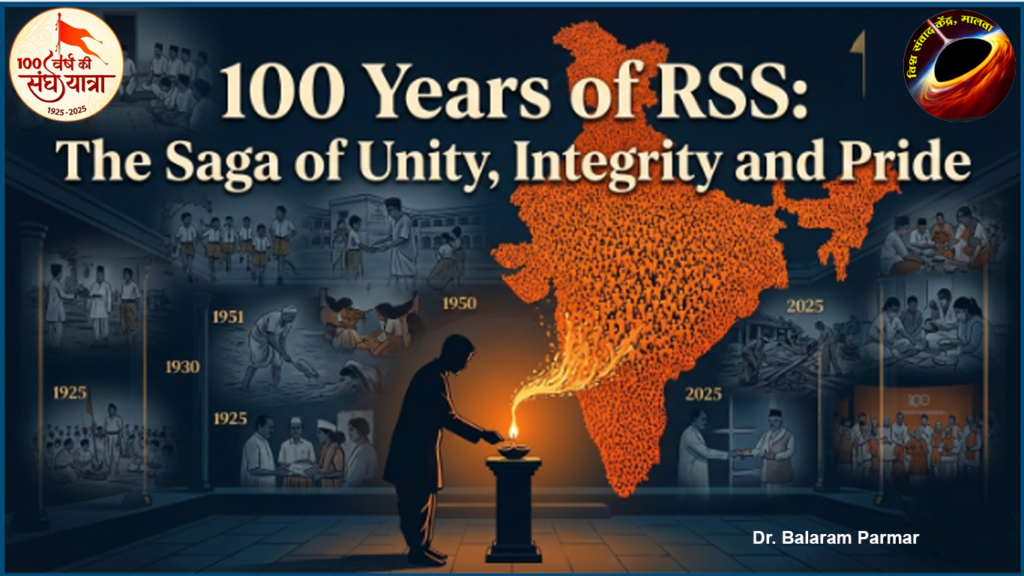
On Vijaya Dashami, 27th September 1925, in the courtyard of Mohite Wada, Nagpur, a young doctor lit a lamp that would not flicker for 100 years. Dr. Keshav Baliram Hedgewar started with 5-6 boys. Today, that flame illuminates over 60,000 daily shakhas across Bharat and beyond.
The Rashtriya Swayamsevak Sangh completes 100 years in 2025. This is not the story of a political party or a corporation. This is the saga of an idea: “Nation First”. It is the story of millions of volunteers who chose “Organization without power, Service without publicity” as their life mantra.
In an age of noise, the RSS chose silence and discipline. In an age of division, it chose ‘Ekta’. In an age of self, it chose ‘Seva’. This is the story of that tempest of unity, integrity and pride.
The Sangh in Brief:
The RSS was founded to build character and awaken national consciousness. Its structure is simple and powerful: the daily ‘shakha’- one hour of physical training, games, prayer, and baudhik – intellectual discussion.
Over 100 years , the Sangh stands as the world’s largest voluntary cultural organization. It has no membership register, no election for posts, and no balance sheet of power. Yet it has built the largest network of schools, labor unions, student bodies, and service projects in India. Its centenary theme for 2025 is “100 Years of Nation Building”.
Chronological Development: 100 Years under 6 Sarsanghchalaks:
The growth of RSS can be best understood through the vision of its 6 Sarsanghchalaks. Each era added a new brick to the edifice of national reconstruction.
Era 1: Dr. K. B. Hedgewar (27 Sep 1925 – 21 Jun 1940)
Dr. Hedgewar was a revolutionary who believed that political freedom without cultural strength was hollow. His goal was “character building and national awakening.”
He gave the Sangh its basic structure – ‘daily shakha’, ‘weekly baudhik’, monthly ‘shivir, and annual Sangh Shiksha Varg. Starting with 1 shakha, by 1940 RSS had spread to all major provinces of undivided India.
Key Idea: “Hindu Sangathan” was not about exclusion, but about organizing society for national strength.
Legacy: He laid the foundation of selfless service. When asked about power, he said a Swayamsevak seeks no post. This principle still guides the Sangh.
Era 2: M. S. Golwalkar “Guruji” (21 Jun 1940 – 5 Jun 1973)
Guruji led the Sangh for 33 years – its longest and most testing phase. His goal was ideological consolidation and all-India spread.
He wrote Bunch of Thoughts, which became the intellectual bedrock of the Sangh. After Mahatma Gandhi’s assassination in 1948, RSS faced a ban. Guruji accepted the ban with discipline, cooperated with the inquiry, and was given a clean chit by the government. This proved the Sangh’s commitment to the Constitution and law.
Significance: Under him, RSS went from a regional body to a national movement. Shakhas started in every state and district.
Legacy: He transformed the Sangh into an all-India cultural force that could withstand state repression.
Era 3: Madhukar Dattatraya Deoras “Balasaheb” (5 Jun 1973 – 11 Mar 1994)
Balasaheb took the Sangh “from shakha to society”. His slogan was “Samajik Samarasata”- social harmony.
During the 21-month Emergency of 1975, the RSS was banned again. Thousands of Swayamsevaks went underground, published cyclostyled newsletters, and led Satyagraha. This period forged the Sangh’s link with democracy and civil liberties.
Sangh Parivar: This era saw the organized expansion of affiliates. Vidya Bharati for education, VHP for cultural work, BMS for labor, ABVP for students, and later ‘BJP: for political engagement. Seva Bharati was formally started to coordinate social service.
Legacy:RSS moved beyond the shakha ground into schools, factories, villages, and tribal areas.
Era 4: Rajendra Singh “Rajju Bhaiya” (11 Mar 1994 – 10 Mar 2000)
A physicist by training, Rajju Bhaiya opened the doors of the Sangh to intellectuals, media, and the middle class.
He championed “Panch Parivartan” – the five transformations: Social Harmony, Family Values, Environmental Consciousness, Swadeshi, and Civic Duties. During the Kargil War in 1999, RSS volunteers ran blood donation camps and supported soldiers’ families. After natural disasters, the Sangh’s relief work was widely covered.
Significance: Under him, RSS became more acceptable in mainstream discourse. He proved that cultural nationalism could have a scientific and rational voice.
Legacy: Made the Sangh’s ideas debatable, discussable, and respectable in universities and drawing rooms.
Era 5: K. S. Sudarshan (10 Mar 2000 – 21 Mar 2009)
Sudarshan ji focused on Swadeshi, environment, and Kutumb Prabodhan – family enlightenment.
RSS relief became highly structured. After the Gujarat Earthquake 2001, volunteers were first on ground with food and shelter. After the 2004 Tsunami, Sangh teams worked for months in Tamil Nadu and Andaman.
He strengthened Hindu Swayamsevak Sangh – HSS, which today is active in 40+ countries. From USA to UK to Australia, shakhas now serve the Indian diaspora with yoga, language classes, and cultural camps.
Legacy: He connected the Sangh’s work with ecology and economic self-reliance, aligning it with global concerns.
Era 6: Dr. Mohan Bhagwat (21 Mar 2009 – Present)
Under Dr. Bhagwat ji, the Sangh entered its Shatabdi Varsh. The goal is clear: “To reach every household and make India a Vishwaguru.”
Covid-19: In 2020-21, RSS became the first responder. Through Seva Bharati, volunteers ran community kitchens – “Sangh Ki Rasoiya”, distributed ration, arranged oxygen cylinders, and even performed last rites when families could not. Over 1,60,000 seva projects were active. Today there are 60,000+ daily shakhas. 5+ lakh Swayamsevaks are trained every year in 1-year and 3-year Sangh Shiksha Vargs.Vidya Bharati runs 12,000+ schools with 35 lakh students, blending Indian values with modern education, now aligned with NEP-2020.
Legacy: The Sangh’s image has shifted from ideological to service-oriented. It is now recognized by the government and society for disaster response and nation-building.
Centenary Year 2025: Focus on reaching every household.
Why RSS has Significance and Recognition Today:
1. Continuity: For 100 years the structure has not changed – daily shakha. No election, no power post. This continuity builds trust.
2. Cadre-based Model: The _“Sangh School produces disciplined citizens. A doctor, teacher, or soldier trained in shakha carries those values to every profession.
3. Service before Self: From 1948 to Covid, the shift is clear. The public now sees RSS first as a service organization. Seva Bharati is the largest volunteer network in disaster zones.
4. Cultural Preservation: Work on Indian languages, history, yoga, and festivals aligns directly with NEP-2020 and the Indian Knowledge System.
5. Social Harmony: The current agenda Panch Parivartan directly addresses modern challenges – unity, environment, family breakdown, and civic sense.
6. Non-Political Influence: The RSS does not contest elections. Yet it provides ideological clarity and human resources for national work, making it a unique civil society force.
The Tempest Continues:
From Dr. Hedgewar’s 1 shakha to Shri Mohan Bhagwat’s 60,000 shakhas, the journey of 6 Sarsanghchalaks shows three things: continuity, adaptability, and service.
The core has never changed. Organization without power. Service without publicity.
The Shatabdi in 2025 is not a full stop. It is a launchpad. The goal for the next 100 years is ambitious but simple: to contribute to making India a Vishwaguru through selfless service.
In a world torn by identity politics, the RSS offers a different model – of unity in diversity, pride in heritage, and integrity in action. That is why, 100 years on, the “Tempest of Nation Unity and Pride” that Dr. Hedgewar started, still rages on – not as a storm of destruction, but as a storm of construction.
Jai Hind. Bharat Mata ki Jai.
=================
Author is a retired Principal from Kendriya Vidyalaya Sangathan & a member of Vidya Bharti Madhya Kshetra ,Madhya Pradesh and Madhya Pradesh book writing and monitoring commity government of Madhya Pradesh.