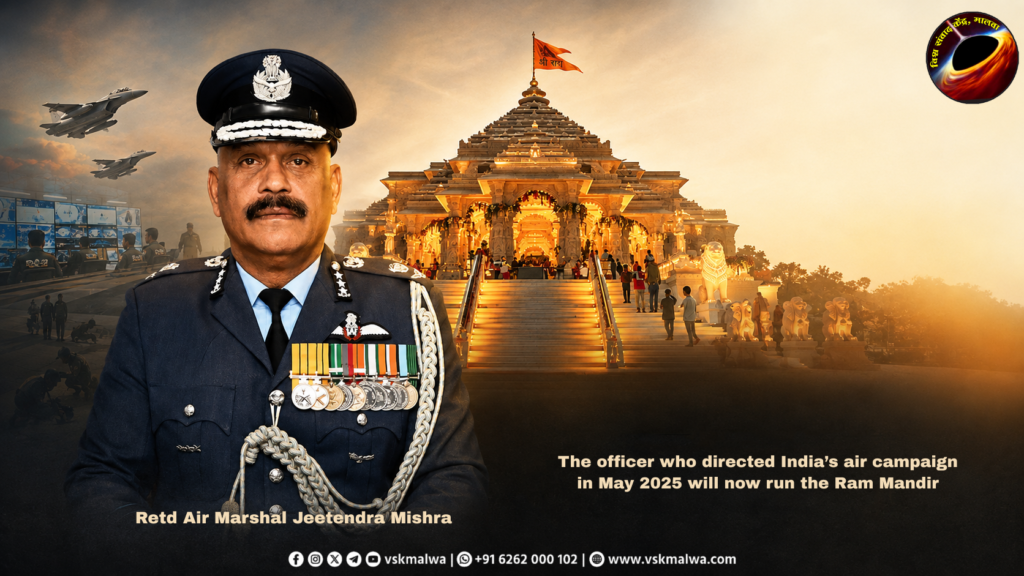
The officer who directed India’s air campaign in May 2025 will now run the Ram Mandir
In the early hours of May 7, 2025, Indian aircraft struck nine terror facilities across the western border. The mission carried a name chosen with unusual care. Operation Sindoor was Bharat’s answer for the women, widowed on April 22 when terrorists murdered 26 innocents, most of them tourists who had gone to see a valley in spring.
What the country followed on television over the next four days, the strikes, the interceptions, the response to every escalation, was directed from the operations rooms of the Indian Air Force’s Western Air Command. The man at the head of that command, on whose judgement every sortie finally rested, was Air Marshal Jeetendra Mishra.
Sixteen months later, the officer who ran Bharat’s western air war has been chosen for a very different charge. The Shri Ram Janmbhoomi Teerth Kshetra Trust has named him Chief Executive Officer of the Ram Mandir at Ayodhya.
As Air Officer Commanding-in-Chief of Western Air Command, Mishra held the senior most field appointment in the Air Force at the most sensitive moment in a generation. Roughly 45,000 airmen and 4,000 officers answered to him, guarding the most contested stretch of Bharat’s airspace. When the government decided that Pahalgam would not go unanswered, it was his command that carried the weight of the reply.
The Air Force’s own verdict on his part in it came on Independence Day, when the President conferred on him the Sarvottam Yudh Seva Medal, the nation’s highest decoration for wartime distinguished service. Only ten officers have received it since it was instituted in 1980.
None of this happened by accident. Mishra’s career reads like one long preparation for responsibility. Born in Deoria in eastern Uttar Pradesh, a few hours from Ayodhya, he joined the National Defence Academy in 1983 and was commissioned a fighter pilot in December 1986. He went on to qualify as an experimental test pilot, one of the rarest specialisations in military aviation, and served as Chief Test Pilot of both the Air Force and Hindustan Aeronautics Limited, flying machines whose flaws were still being discovered.
When terrorists attacked the Pathankot air base in January 2016, the Air Force hand picked him to take over the station and rebuild its administration and security from the ground up. He later commanded the Aircraft and Systems Testing Establishment in Bengaluru, one of only seven institutions of its kind in the world, where his job was to keep HAL, DRDO and civilian scientists moving to the Air Force’s deadlines. In between came three years in capital procurement at Air Headquarters, overseeing 75 projects at a time and leading the Air Force’s share of the first emergency procurement tranche of 2019 and 2020. He studied war management at the Air Command and Staff College in the United States and strategy at the Royal College of Defence Studies in London.
Fighter pilot, test pilot, base commander, financial steward, war commander. It would be hard to design a record better suited to an institution that must combine devotion with administration on a national scale.
The search that found him was itself unusually rigorous. The Trust’s committee, headed by Justice Permod Kohli with Lieutenant General V.K. Chaturvedi and nuclear scientist Dr. Suresh Hawre, worked through 5,585 applications through secretariat lead by Sameer Panda using AI, Information technology assisted screening and multi city verification teams, then online assessments, before sixteen finalists were interviewed face to face in Ayodhya on August 11 and 12. The panel of three names went to the Trust on September 1.
In May 2025, the nation asked Jeetendra Mishra to command its response. In September 2026, Ayodhya has asked him to serve. He said yes, both times.