“Whoever controls the media, controls the mind”[i]
The nature of political contestation in the twenty-first century is being transforming rapidly in the way grievances are articulated, amplified, and converted into political narratives.
we are witnessing a scenario where a singular grievance is posted, a hash tag circulates, and within a matter of hours, a localized dissatisfaction metastasizes into a formidable national narrative.[ii]
This is the new architecture of mass mobilisation, fundamentally altering the calculus of statecraft.
Since the pandemic, our own neighbourhood in South Asia has served as a real-time laboratory for this phenomenon from Myanmar to Pakistan, and Sri Lanka to Bangladesh, Nepal, and now India.
we see a common transformation. Social media has evolved into the very infrastructure through which underlying political grievances acquire unprecedented speed, visibility, and organizational reach.[iii]
We must recognize that the post-COVID landscape has accelerated the digitalization of society in ways that directly challenge the traditional institutional procedure on information.[iv]
For a vast demographic of young people, the digital realm has transitioned from a space of mere entertainment to the primary theatre of political debate and identity formation.[v]
Historically, political communication was mediated by established gatekeepers, political parties, the press, trade unions, and civil society.[vi]
Today, that procedure has been comprehensively disrupted.
A citizen can now record an event and distribute it globally before conventional media or the state apparatus can even formulate a response.
The state, of course, retains its legitimate control over physical force and formal institutions, but it now faces a society that wields asymmetric power over the circulation of information.
The political battlefield is therefore no longer confined to the streets, it is actively and fiercely contested on the screen. If one looks objectively at the recent trajectory of our region, the evidence of this dual battlefield is compelling.
In Myanmar, when the state sought absolute control over the physical domain,[vii] the digital network organically evolved into a parallel resistance, proving that the more a state attempts to suppress information, the more the act of information-sharing becomes a deeply political act of defiance.
Similarly, the Pakistani experience illustrates that physical containment of political actors does not automatically yield political containment.[viii]
A state may incarcerate a leader or restrict a physical rally, but it struggles to incarcerate a decentralized digital network.
In Sri Lanka, an undeniable economic collapse was catalysed into a mass movement because digital connectivity allowed citizens to realize their localized hardships were part of a systemic national failure.[ix]
The crisis was rooted in the physical world, but it was the digital network that provided the shared vocabulary and the visual momentum necessary for mass mobilization.
The student-led unrest in Bangladesh and the youth mobilization in Nepal further underscore this strategic rebalancing between state procedure and societal velocity.[x]
In Bangladesh, we saw how the smartphone transforms the consequences of state action, a localized confrontation is recorded, disseminated, and suddenly becomes a national rallying point, proving that while a state can manage a physical incident, it cannot easily manage the narrative aftermath of its imagery.
Nepal provided a distinctly cautionary tale for policymakers, the state’s attempt to restrict social media platforms did not quell the underlying anger but instead became the very catalyst for the protest, demonstrating that digital repression can backfire by creating a new, immediate political grievance.[xi]
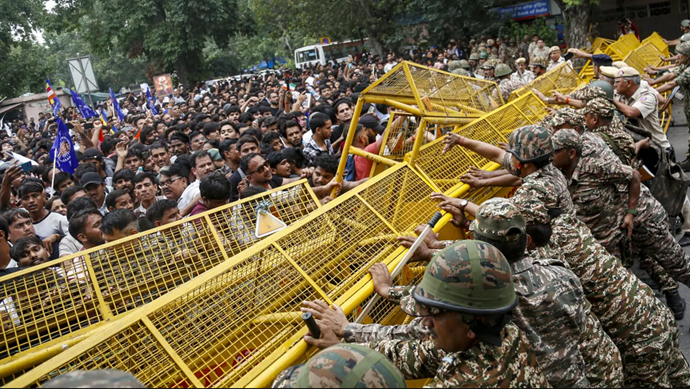
In India, the CJP agitation showcased the maturation of this model into a complex ecosystem. A movement that incubates online inevitably spills into the streets, creating a continuous feedback loop where physical confrontations generate digital narratives, which in turn fuel further physical mobilization and ideological contestation.[xii]
To understand this new dynamic is to acknowledge the five distinct weapons of this digital mobilization, first, the velocity of information that outpaces institutional procedure, second, the disproportionate power of visual narratives, third, the rapid forging of collective political identities, fourth, the tactical advantage of decentralization, and fifth the relentless, on-going contestation of facts. [xiii]
However, we must remain rigorously objective and not mistake digital visibility for ground reality.
A trending hash tag or a viral video is not a national consensus, and social media, in itself, does not manufacture a viral protest.[xiv] The underlying grievances like economic anxiety, unemployment, institutional distrust is entirely physical and deeply societal. Technology is merely the accelerator and the connective tissue.[xv]
The defining strategic challenge of our time is that genuine societal grievances have been weaponized.
For the modern state, navigating this environment requires a nuanced statecraft that comprehends both the street and the screen, recognizing that the ultimate arbiter of political power belongs to those who can convert digital attention into tangible, real-world consolidation.[xvi]
If we dispassionately analyse the trajectory of the CJP protest within this broader framework, we are witnessing a profound structural shift where legitimate, organic student grievances have been entirely cannibalized by vested political interests.[xvii]
What originated as a focused demand for accountability regarding examination irregularities has been systematically hijacked[xviii], its original objectives mutating beyond recognition.
The genuine students are the actual stakeholders in this scenario whom have been steadily replaced on the streets by professional agitators and political goons.[xix]
Consequently, the slogans that once echoed a plea for educational reform have devolved into radicalized[xx], anti-systemic rhetoric designed not to seek solutions, but to perpetuate institutional paralysis.[xxi]
The target of their demands is now in perpetual motion, shifting daily to ensure that no government concession can ever be deemed sufficient, thereby entirely eradicating the very concept of democratic accountability.
This metamorphosis is accelerated by a glaring leadership vacuum, revealing a stark disconnect between the nominal vanguard of the movement and the radicalized mob it purported to lead.[xxii]
Let us be very clear, when the so-called CJP leadership is visibly documented casually eating burgers while their own protesters explicitly refuse to listen to their directives, we are no longer dealing with a structured, disciplined political movement.[xxiii]
It is a sobering reality that the architects of this agitation have entirely lost control of the monster they helped create. Accountability cannot exist when the leadership itself is reduced to mere spectators of their own event, insulated from the chaos they initiated.
The movement has transitioned from a centralized campaign into an autonomous franchise of disruption, where localized mobs operate with absolute impunity, rendering any prospect of negotiation or policy resolution fundamentally replaced.
Consequently, the ground reality of this agitation has become exceptionally dirty, complex, and deeply concerning from a national perspective.
We must recognize that domestic vulnerabilities are invariably exploited by external adversaries, and this protest is no exception.
The strategic calculus has shifted as we see clear indicators of transnational support networks, including ideological and logistical backing from entities like Bangladesh’s Jamaat-e-Islami has infiltrated the discourse.[xxiv]
Anti-state elements and political opportunists have weaponized this fractured environment, repurposing a domestic student issue into a broader campaign of national destabilization.[xxv]
This is no longer merely about a weak examination system, it is about hostile actors utilizing our democratic spaces to wage a proxy conflict against the state, manipulating the narrative to serve transnational geopolitical agendas rather than domestic policy reform.
Crucially, this unexpected evolution is facilitated and accelerated by the weaponization of social media, which acts as an unregulated accelerant that entirely dismantles traditional checks and balances.[xxvi]
The digital ecosystem is fundamentally designed to thrive on a relentless, high-tempo circulation of outrage, deliberately inducing profound psychological fatigue among the broader public.
In any hyper-accelerated environment, the societal capacity to think critically, verify claims, or formulate a measured response is systematically degrading rapidly.
Fact-checking becomes functionally complicated, by the time the truth is established, the digital narrative has already moved five steps ahead, leaving a trail of manufactured outrage.[xxvii]
What is projected on the screen is a highly visible, curated illusion of righteous defiance, completely masking the grim, hijacked, and fractured reality occurring on the streets.[xxviii]
Finally, we must confront the ultimate force multiplier in this new era of cognitive warfare, the deployment of artificial intelligence.
AI does not merely amplify existing grievances, it autonomously generates synthetic narratives, scales transnational propaganda, and floods the information zone with such precision that society loses its capacity to distinguish organic anger from manufactured destabilization.[xxix]
We are seeing synthetic content and algorithmic coordination being utilized to sustain the psychological tempo of the protest, ensuring that the friction between the state and the street never subsides.[xxx]
The state is no longer merely managing a crowd in a public square. It is actively combating anti-national transnational interference through social media.
Over 480 Pakistan-based social media handles involved in coordinated misinformation campaigns were identified and blocked. These accounts spread rumours, fake videos, and edited content to inflame the CJP protests.[xxxi]
The situation is further complicated by open involvement from Khalistani elements. US-based terrorist Gurpatwant Singh Pannun of the banned Sikhs for Justice (SFJ) publicly claimed to have held Zoom meetings with CJP leaders.
He announced $1 million (nearly ₹8-10 crore) in support for the protests, urged agitators to continue until 15 August, and linked it to his broader agenda of India’s disintegration and Balkanisation.[xxxii]
This is the new, sobering reality of streets, modern states security and governances.
[i] https://www.goodreads.com/author/quotes/7855.Jim_Morrison
[ii] https://www.atlantis-press.com/proceedings/gits-hss-25/126023025
[iii]https://publishing.emanresearch.org/CurrentIssuePDF/EmanPublisher_14_5968business-3110221.pdf
[iv] https://pmc.ncbi.nlm.nih.gov/articles/PMC8437806/
[v]https://www.researchgate.net/publication/255703562_Digital_Media_Shapes_Youth_Participation_in_Politics
[vi] https://www.egyankosh.ac.in/bitstream/123456789/108052/1/Unit-14.pdf
[vii] https://www.cfr.org/global-conflict-tracker/conflict/rohingya-crisis-myanmar
[viii] https://newsonair.gov.in/former-pakistan-pm-imran-khan-arrested-after-local-court-finds-him-guilty-in-toshakhana-corruption-case/
[ix] https://carnegieendowment.org/research/2025/08/sri-lanka-aragalaya-protest-movement-oust-wickremesinghe-rajapaksa
[x] https://www.cfr.org/articles/after-gen-z-protests-bangladesh-and-nepal-head-to-the-polls
[xi] https://www.aljazeera.com/news/2025/9/9/nepal-lifts-social-media-ban-after-19-killed-in-protests-report
[xii] https://indianexpress.com/article/cities/delhi/jantar-mantar-protest-live-updates-cjp-abhijeet-dipke-jp-nadda-sonam-wangchuk-hunger-strike-parliament-congress-bjp-10799380/
[xiii] https://www.opindia.com/news-updates/delhi-police-bust-nine-fake-claims-zubair-saurav-das/
[xiv] https://x.com/ptifactcheck/status/2079924294705098771?s=20
[xv]https://www.researchgate.net/publication/383083856_Sociology_of_TwitterX_Trends_Challenges_and_Future_Research_Directions
[xvi] https://2009-2017.state.gov/statecraft/overview/index.htm
[xvii] https://theprint.in/opinion/jantar-mantar-crackdown-cjp/2992744/
[xviii] https://indianexpress.com/article/india/rahul-gandhi-detention-centre-outreach-sonam-wangchuk-cjp-protest-jantar-mantar-10797582/
[xix] https://theprint.in/india/cjp-protest-five-police-personnel-injured-in-wednesdays-clashes-protesters-allege-lathi-charge/2994118/
[xx] https://x.com/Mrsinha/status/2080168063077614072?s=20
[xxi] https://x.com/Dear_Men_Life/status/2078712956771352685?s=20
[xxii] https://x.com/NewsAlgebraIND/status/2079444261498700160?s=20
[xxiii] https://www.thehindu.com/news/national/cjp-jantar-mantar-protest-live-updates-rahul-gandhi-news-abhijeet-dipke-sonam-wangchuk-saurav-das-parliament-session/article71251952.ece
[xxiv] https://x.com/ankitdubeyji_/status/2079596537097998421?s=20
[xxv] https://x.com/BefittingFacts/status/2075071759473365484?s=20
[xxvi]https://www.pib.gov.in/PressReleaseIframePage.aspx?PRID=2073917®=48&lang=2
[xxvii] https://newsonair.gov.in/govt-refutes-false-claims-on-social-media-related-to-student-protest-in-delhi/
[xxviii] https://x.com/PIBFactCheck/status/2080354572061835741?s=20
[xxix] https://x.com/DelhiPolice/status/2080204029192454187?s=20
[xxx] https://x.com/scribe9104/status/2080195694703595749?s=20
[xxxi] https://x.com/DelhiPolice/status/2080328683366346883?s=20
[xxxii] https://organiser.org/2026/07/22/371242/bharat/khalistan-terror-group-enters-cjp-protests-sfjs-pannun-offers-1-million-threatens-indias-disintegration/