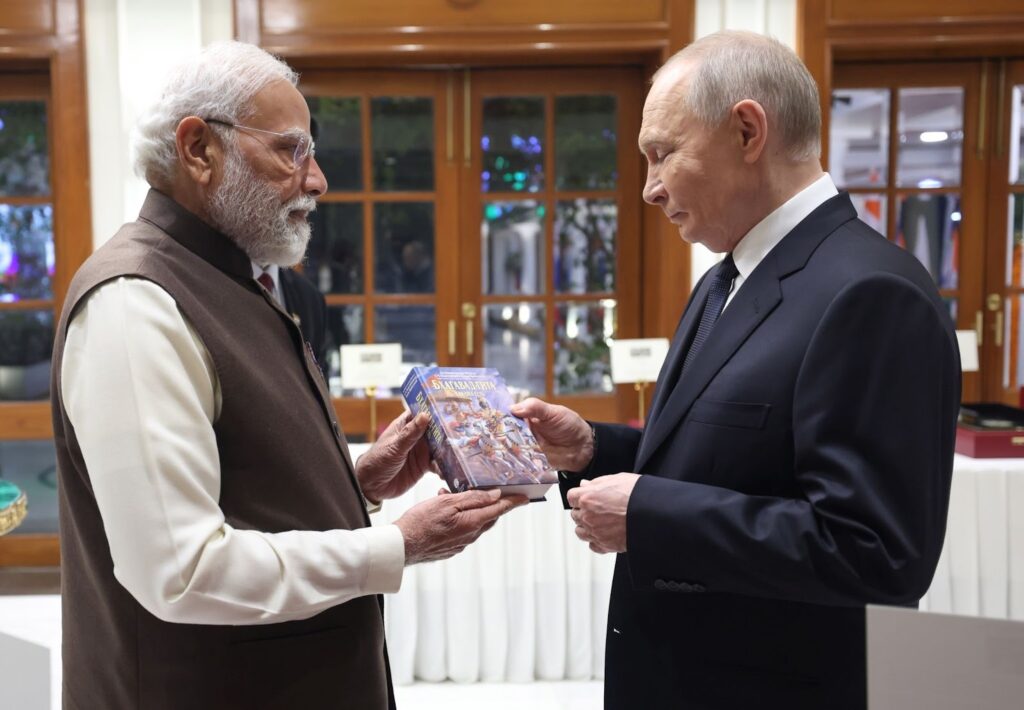
In an era defined by intensifying strategic rivalry, economic coercion, and persistent narrative conflict, even limited diplomatic gestures carry strategic weight. As major powers increasingly rely on sanctions, signalling, and military posturing, India chose to anchor a high-level diplomatic moment in a civilizational instrument. On December 4, 2025, Prime Minister Narendra Modi presented President Vladimir Putin with a Russian translation of the Shreemad Bhagavad Gita at Delhi’s Palam Airport. Notably, this was Putin’s first visit to India since Russia’s full-scale invasion of Ukraine in February 2022, and it marks his sixth official state/summit visit to India since first assuming the presidency in 2000. The gesture was deliberate and calibrated. It reflected the application of cultural diplomacy at a time when geopolitical communication is dominated by coercive messaging. While such actions do not alter material power balances, they shape diplomatic atmospherics and establish the normative frame within which negotiations unfold.
Cultural diplomacy, defined as the exchange of ideas, information, art, and other cultural expressions to build long-term mutual understanding, functions as a structural complement to hard power. It operates in the domain of perception, legitimacy, and influence. In high-friction geopolitical environments, symbolic acts when contextually grounded and strategically timed stabilize engagement channels, reinforce credibility, and sustain dialogue even under conditions of systemic rivalry.
The immediate question is Why the Bhagavad Gita? misses the strategic logic if framed in personal or theological terms. The relevance lies not in the recipient but in the instrument. The Gita is an established ethical framework introduced into a period marked by strategic uncertainty. Structured as an 18-chapter dialogue of approximately 700 verses within the Mahabharata, it is dated broadly between the 5th century BCE and the 2nd century CE. Its core principles dharma (duty), nishkama karma (detached action), and samatva (equanimity) constitute a coherent philosophy of decision-making under pressure. Its intellectual transmission spans from Adi Shankaracharya to Sri Aurobindo and Mahatma Gandhi, who described it as his “spiritual dictionary.”
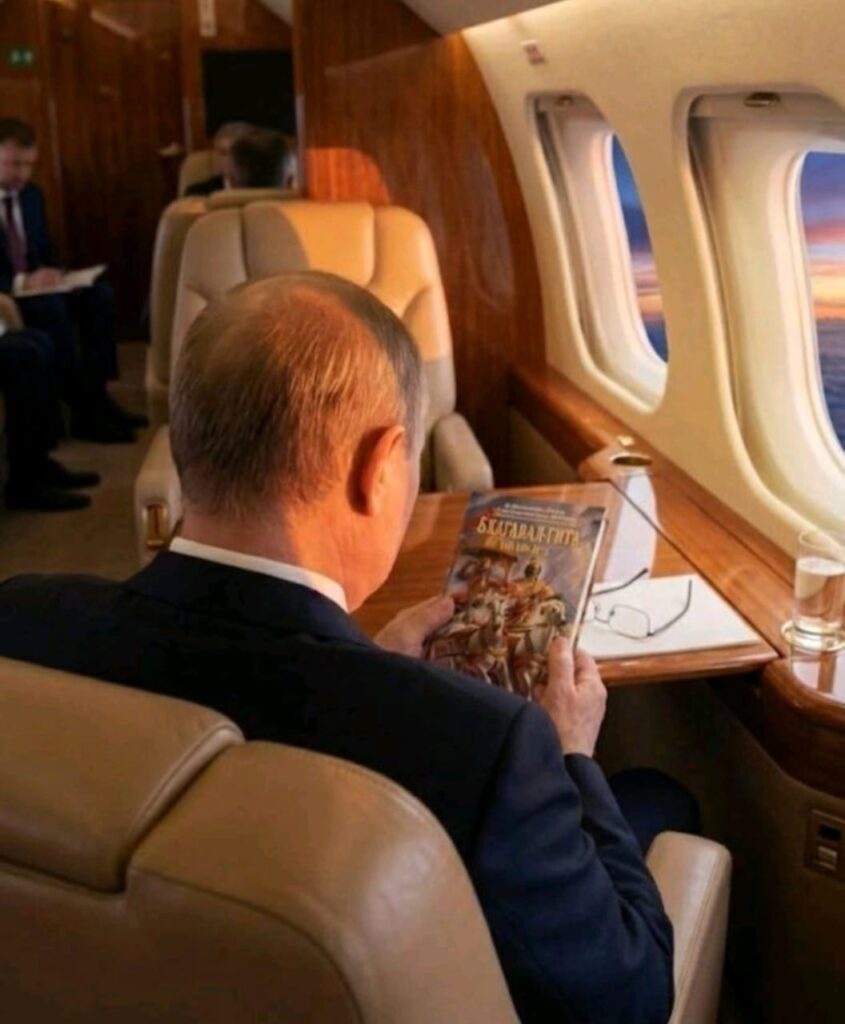
Its global circulation through translations, commentaries, and modern scientific discourse including Oppenheimer’s reference during the nuclear age confirms its trans-civilizational penetration. From a strategic perspective, the Russian-language Gita functions as normative signalling rather than personal instruction. It inserts a compact ethical framework into an arena of high-stakes statecraft. It indicates that alongside kinetic and economic power, India continues to deploy civilizational capital as an instrument of influence. The battlefield metaphor in the Gita represents both internal and external conflict. The operative instruction detached duty is codified in Bhagavad Gita 2.47:
कर्मण्येवाधिकारस्ते मा फलेषु कदाचन।
मा कर्मफलहेतुर्भूर्मा ते सङ्गोऽस्त्वकर्मणि॥
“You have a right to action alone, never to its fruits. Do not let the fruits of action be your motive, nor let your attachment be to inaction.”
In contemporary strategic terms, this principle aligns with crisis-statecraft pursuing objectives without emotional escalation, impulsive retaliation, or reputational vanity. It is a doctrine of controlled execution under pressure. Krishna’s guidance to Arjuna closely parallels the architecture of modern just war theory. It integrates jus ad bellum (conditions for entering war) and jus in bello (ethical limits during war). The framework does not legitimize violence indiscriminately; it constrains the use of force through proportionality, necessity, and discrimination.
The Gita, therefore, operates as a regulatory ethical system for conflict decision-making, not a doctrine of militarized absolutism. The contemporary relevance of the Gita is reinforced by J. Robert Oppenheimer’s post-Hiroshima citation of 11.32:
कालोऽस्मि लोकक्षयकृत् प्रवृद्धो लोकान्समाहर्तुमिह प्रवृत्तः।
ऋतेऽपि त्वां न भविष्यन्ति सर्वे येऽवस्थिताः प्रत्यनीकेषु योधाः॥
“I am Time, the great destroyer of worlds, engaged to annihilate the peoples. Even without you, all the warriors arrayed here on both sides shall cease to exist.”
The verse articulates the scale of annihilatory power while simultaneously imposing the burden of ethical restraint. In policy terms, this translates into institutionalized safeguards: nuclear arms control regimes, cyber escalation management, information warfare thresholds, and anticipatory governance for climate and displacement shocks. The Gita’s framework is not fatalistic, it is restraint-based and accountability-driven. India’s diplomatic worldview is structurally anchored in Vasudhaiva Kutumbakam “the world is one family” first articulated in the Maha Upanishad and formally operationalized as the theme of India’s G20 presidency “One Earth, One Family, One Future.” Prime Minister Modi formally advanced this framework at the United Nations General Assembly in 2014. This model integrates Nehruvian strategic autonomy with civilizational assertion. It positions India as a systemic stabilizer for the Global South, reflected in the G20’s inclusion of the African Union as a permanent member.
Critiques of the Vishwa Guru framework as hierarchically coded prompted an operational shift toward Vishwa Mitra, a posture of multi-aligned partnership without bloc subordination. This reflects maximum engagement without alliance entanglement.Within this architecture, the Gita functions as a stabilizing reference point in India–Russia engagement. For India, confronting U.S. tariff pressure and sustained Chinese border friction, the logic of nishkama karma enables strategic persistence without reactive escalation simultaneously deepening defence integration with France and institutional consolidation within BRICS.
For Russia, under long-duration sanctions and strategic compression, the framework rationalizes strategic patience and sovereignty defence without civilizational hostility. This aligns with Moscow’s declared non-civilizational confrontation posture. Jointly, amid structural prolongation of the Ukraine conflict and Arctic resource competition, Vasudhaiva Kutumbakam translates into a doctrine of dharmic multipolarity conflict management through multilateral platforms such as RIC and EAS, with climate stabilization prioritized over arms acceleration. India’s posture is frequently criticized as idealist when measured against its calibrated response to the Israel–Gaza war. Similar critiques followed the April 2025 Pahalgam terror attack that killed 26 civilians. These critiques underestimate the long-cycle accumulation of civilizational power. As Samuel P. Huntington observed, the primary fault lines of the post–Cold War order are cultural in character.
“World politics is entering a new phase… It is my hypothesis that the fundamental source of conflict in this new world will not be primarily ideological or primarily economic. The great divisions among humankind and the dominant source of conflict will be cultural. Nation states will remain the most powerful actors in world affairs, but the principal conflicts of global politics will occur between nations and groups of different civilizations. The clash of civilizations will dominate global politics. The fault lines between civilizations will be the battle lines of the future.”
In such an environment, power consolidation depends not only on coercive assets but on narrative authority, normative legitimacy, and civilizational continuity categories long embedded in India’s dharma-based worldview. Soft power thus becomes a force multiplier, not a cosmetic instrument. The precedent is well established. Swami Vivekananda’s 1893 address in Chicago influenced Western civilizational perception through moral authority rather than military leverage. Contemporary “Gita Diplomacy” extends this lineage. Prime Minister Modi’s 2024 Moscow engagement combined the symbolic nine strategic agreements on defence production, nuclear cooperation, Arctic energy, and a trade expansion target of US$100 billion by 2030.
Material alignment and civilizational signalling now operate as parallel tracks. This reflects realism adapted to a civilizational system. Where Huntington projected cultural collision, India advances narrative arbitration grounded in ethical continuity. As former RAW chief Vikram Sood has stated:
“Real power comes not from the barrel of a gun
but from those who control the narrative.”
In an information-saturated global order defined by permanent narrative conflict, India’s long civilizational memory, adaptive pluralism, and discipline of restraint form a durable strategic asset. Its influence operates through voluntary alignment rather than coercion. This constitutes the most sustainable form of geopolitical leverage available in the emerging multipolar system.
Punit Shyam Gore (MA Defence and Strategic Studies) is an alumnus of Rashtriya Raksha University, (an institution of national importance) under the Ministry of Home Affairs, Government of India.
Source:
- https://x.com/narendramodi/status/1996640866468090252?s=20
- https://www.theguardian.com/world/2025/dec/04/putin-and-modi-to-meet-amid-politically-treacherous-times-for-russia-and-india
- https://x.com/narendramodi/status/1996791969503498468?s=20
- https://www.vedanet.com/indias-soft-power-and-cultural-diplomacy-the-role-of-yoga-and-dharmic-traditions/
- https://blogs.icrc.org/religion-humanitarianprinciples/bhagavad-gita-ethics-war/
- https://www.cambridge.org/core/journals/modern-intellectual-history/article/abs/rethinking-knowledge-with-action-v-d-savarkar-the-bhagavad-gita-and-histories-of-warfare/FB6D183E28BE43B51C5750DC3DEFAE13
- https://www.ias.edu/oppenheimer-legacy
- https://ia802907.us.archive.org/8/items/gitaandoppenheimer/Gita%20and%20Oppenheimer_text.pdf
- https://static.pib.gov.in/WriteReadData/specificdocs/documents/2025/jun/doc2025618572301.pdf
- https://ddnews.gov.in/en/indias-transformative-foreign-policy-a-decade-of-strategic-diplomacy/
- https://www.lowyinstitute.org/the-interpreter/why-has-india-reimagined-its-role-vishwaguru-vishwamitra
- https://www.newsx.com/explainer/pm-narendra-modi-russian-president-vladimir-putin-delhi-visit-india-russia-annual-summit-russian-bhagavad-gita-gift-why-modi-chose-gita-for-putin-cultural-civilizational-diplomacy-explained-120914/
- https://www.brookings.edu/articles/vasudhaiva-kutumbakam-for-the-21st-century__trashed/
- https://www.mea.gov.in/Images/CPV/38005_Final-MEA-AR-2023-English.pdf
- https://www.mea.gov.in/bilateral-documents.htm?dtl/38450/Kazan_Declaration__Strengthening_Multilateralism_For_Just_Global__Development_And_Security
- https://www.csis.org/analysis/what-led-recent-crisis-between-india-and-pakistan
- https://msuweb.montclair.edu/~lebelp/1993SamuelPHuntingtonTheClashOfCivilizationsAndTheRemakingofWorldOrder.pdf
- https://belurmath.org/swami-vivekananda-speeches-at-the-parliament-of-religions-chicago-1893/
- http://en.kremlin.ru/supplement/6168
- https://www.hindustantimes.com/books/review-the-ultimate-goal-by-vikram-sood/story-hjdxXLqc0ZNDfD7yBmkkmM.html
- https://www.pib.gov.in/PressNoteDetails.aspx?NoteId=156315&ModuleId=3®=3&lang=1